User Login

Syndicate

Select one of the RSS buttons below to be notified of new articles when they are published on this site.

What is RSS?


The principles of political economy

The Henry George Foundation of Great Britain

is pleased to offer

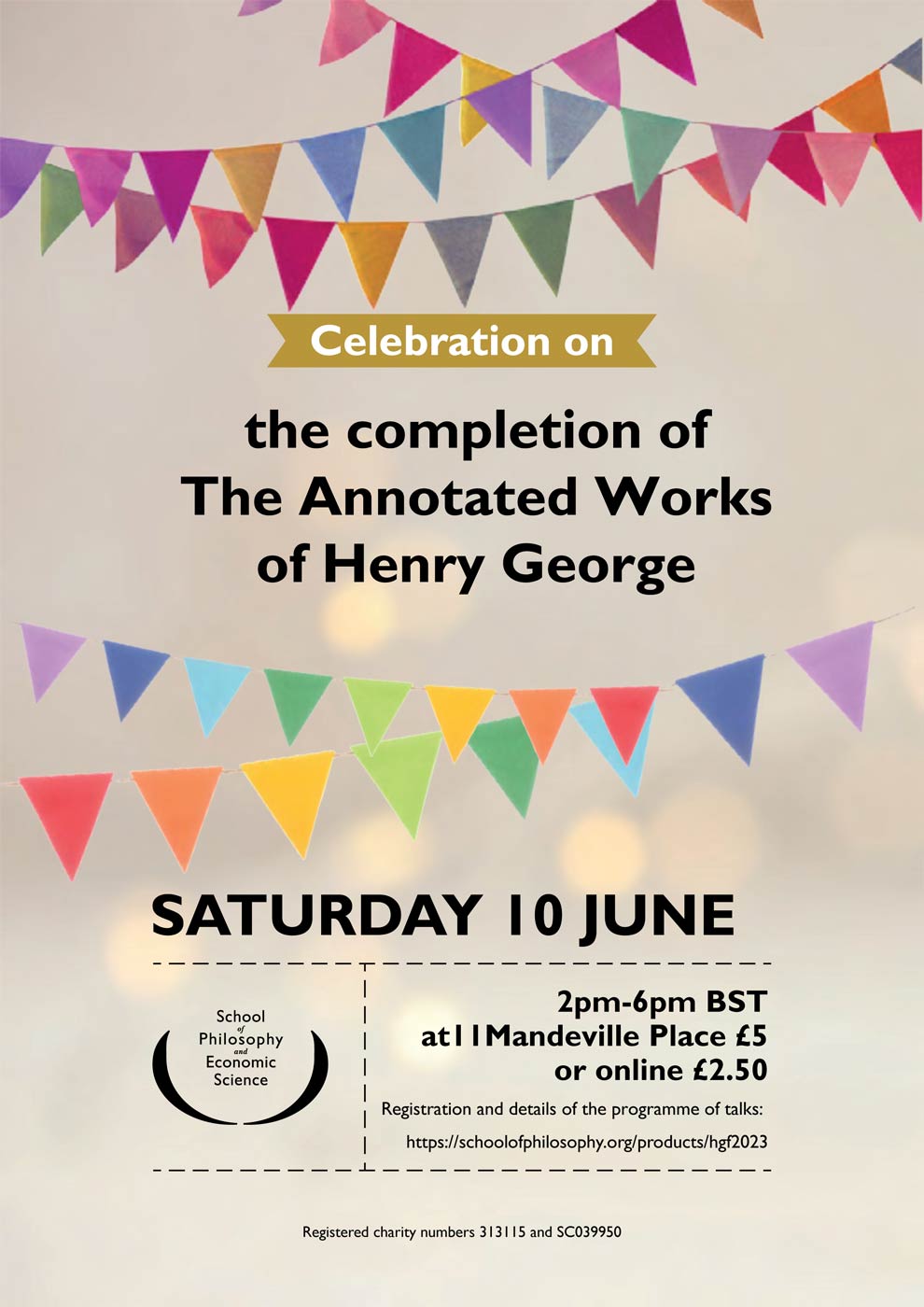
A 10-week course


 Political Economy and Economic Justice

Presented By David Triggs - Executive Chairman 


Fridays 6.40pm – 8.10pm 

Commencing 8th May 2009

At 

11 Mandeville Place, London W1

(by kind permission of the School of Economic Science)


Henry George described Political Economy as ‘the science that treats of the nature of wealth, and the laws of its production and distribution’. In this course we shall study the principles he identified in his various books, speeches and publications and show how those principles hold the economic key to justice, peace and prosperity throughout the world today. Starting with an appreciation of the nature of, and relationships that connect, individuals, civilised society and their physical environment we shall explore critical moral and practical questions pertaining to value, wealth, property, and a just basis for public revenue and private income. We shall consider the functions of land, labour, capital and money in a modern economy - and the returns that are due to their respective providers. 


The series is designed so that each talk may be appreciated on its own whilst a more comprehensive appreciation of Henry George's ideas will be available to those who attend the whole series. It is open to all, and those with no previous exposure to academic economic teaching should find it stimulating and enjoyable - those with such experience will find we challenge some currently accepted theories opinions and beliefs. 

The course is open to all and those with no previous exposure to academic economic teaching should find it stimulating and enjoyable – those with such experience are likely to find that we challenge some currently accepted theories, opinions and beliefs.

There is no charge for attendance but students are invited to make a donation to the Foundation according to their means and their valuation of the course and the work of the Foundation. 

All Welcome

Numbers are limited so please reserve your place by registering in advance in person at the office of the School of Economic Science at 11 Mandeville Place or by telephone 0207 034 4000.

 
House of Commons Seminar

Coalition for Economic Justice


REPORT: HOUSE OF COMMONS SEMINAR ON LAND VALUE TAXATION

Organised by The Coalition for Economic Justice 
Hosted by Vince Cable MP 

Panel of Speakers: 

Sir Sam Brittan,  Financial Times 
Fred Harrison*,  Land Research Trust 
Prof Iain McLean,  Professor of Politics– Oxford University 
Ashley Seager,  The Guardian 
Molly Scott Cato,  Green Party Economics speaker 
David Triggs,  Henry George Foundation 

* Author of Boom Bust: House Prices, Banking and the Depression of 2010. 

There was standing room only in Committee Room 5 at the House of Commons on Tuesday evening for a lively and stimulating seminar hosted by Vince Cable. The Coalition for Economic Justice – a recently formed grouping of concerned organisations across and beyond the political spectrum– believes that the private appropriation of community-created site values is lethal in its effect on our economic arrangements, dooming every economic upswing to an ultimate collapse. To end this cycle of boom and bust it is vital that the Government has some control over the level of property prices. Land value taxation would give it that control. 

The House of Commons seminar held last Tuesday was aimed at parliamentarians and policymakers. It examined the advantages of land value taxation, how it might be introduced and how transitional problems could be dealt with. 

As Sir Sam Brittan saw it, the case for LVT was clear and simple. But perversely, people find this difficult to grasp; they expect complexity in taxes. Being a tax on unearned value increment, LVT was no disincentive to Labour or Capital. As a temporary expedient, pending the full introduction of LVT, he advocated the auctioning of planning permissions. 

Ashley Seager of The Guardian cited instances where public expenditure had led to massive increases in property (i.e., land) prices. In one case, the building of a school had led to such a big increase in local property prices that teachers in the school could not afford to live in the area. As the land of this country is provided free of charge by nature, “rising property prices do not raise national wealth one single penny”. They serve no useful economic purpose and are an obvious target for taxation. 

Professor Iain McLean explained how, as a member of the independent expert group set up by the Calman Commission, he was looking at LVT as a way of financing public services in Scotland and Wales. LVT would replace council tax, business rates and stamp duty. 

From a Green perspective (Molly Scott Cato), land is a trust for the people, its life-giving properties to be preserved from one generation to the next. LVT, which aims to curb private profiteering from the nation’s patrimony, was seen as a valuable tool in this connection. 

The groundwork for the panel discussions was set out by David Triggs in his opening address. “The challenge that confronts those interested in establishing a just and equitable division of the fruits of production lies essentially in recognising that land values impound that part of the value created which is attributable to factors external to the individual, e.g., the country’s infrastructure, the system of governance, law and order and the density of population. It is manifestly unfair to tax the individual on what he produces while those community-created values are provided tax-free to the benefit of the landowner. These land values, arising essentially from location, should be the primary source of taxation.” 

Fred Harrison reinforced this message. He showed how failure to collect location value led to diminished opportunity and life expectancy at the marginal location. 

James Black (a sixth-former) said LVT made common sense to the young and the opportunity should not be missed. 

This seminar is the first step in a campaign to interest parliamentarians in the formation of an all party parliamentary group on Land Value Taxation. 

Organisations involved in the CEJ include:

Christian Council for Monetary Justice (CCMJ), Global Justice Movement (GJM), Henry George Foundation (HGF), Land is Free (LF), Land Value Taxation Campaign (LVTC), Labour Land Campaign (LLC), Liberal Democrat Action for Land Taxation and Economic Reform (ALTER), Professional Land Reform Group (PLRG), School of Economic Science (SES), Social Liberalist Party (SLP), Systemic Fiscal Reform Group (SFRG), The 1909 Group

 
Henry George's teaching very relevant in today's financial crisis

Henry George and the Financial Crisis

Henry George's teaching  was not just restricted to the single tax issue. It extended to many areas of political economy and included the question of the issuance of money which lies at the heart of the present financial crisis. In this extract he states clearly his views on the injustice of handing over the privilege of issuing money to private institutions:


..... it is the business of government to issue money. This is perceived as soon as the great labour-saving invention of money supplants barter. To leave it to everyone who choses to do so to issue money would be to entail general inconvenience and loss, to offer many temptations to roguery, and to put the poorer classes of society at a great disadvantage. These obvious considerations have everywhere, as society became well organized, led to the recognition of the coinage of money as an exclusive function of government.


When, in the progress of society, a further labor-saving improvement becomes possible by the substitution of paper for the precious metals as the material for money, the reasons why the issuance of this money should be made a government function become still stronger........


Yet instead of doing what every public consideration impels us to, and assuming wholly and fully as the exclusive function of the General Government the power to issue paper money, the private interests of bankers have, up to this time, compelled us to the use of a hybrid currency, of which a large part, though guaranteed by the General Government, is issued and made profitable to corporations.


The legitimate business of banking—the safe-keeping and loaning of money, and the making and exchange of credits, is properly left to individuals and associations; but by leaving to them, even in part and under restrictions and guaranties, the issuance of money, the people of the United States suffer an annual loss of millions of dollars, and sensibly increase the influences which exert a corrupting effect upon their government.


From ‘Social Problems’   CHAPTER XVII. The Functions of Government

 for more on Henry George's concept of money go to AMI 


Read more...
 

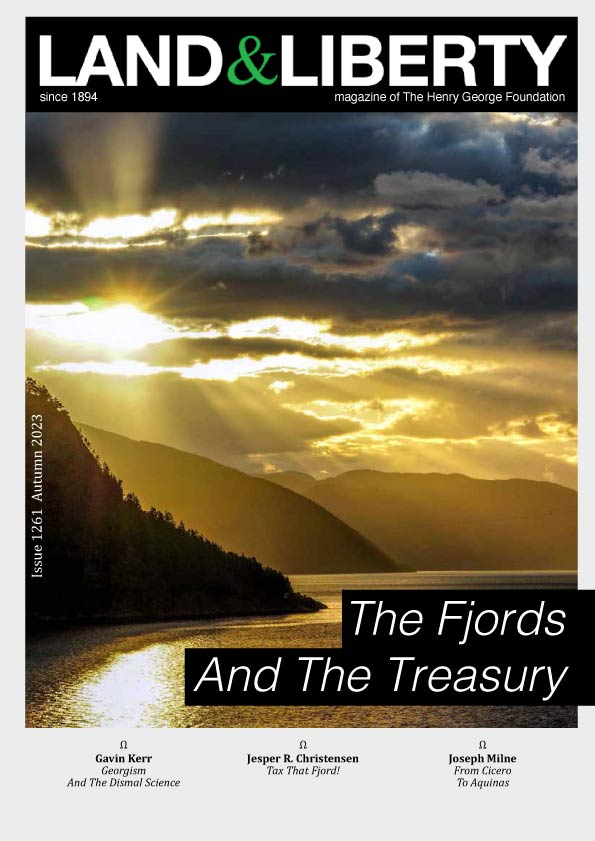
Land & Liberty Magazine

Advertisement

Make a donation


Click here for other donation options.

Upcoming Events

July
lunch and informal conversation
July 10, 2009 (1:00 pm)

Talk
July 10, 2009 (2:30 pm)
Dr Joseph Milne will speak on Thomas Aquinas and Natural...

View Events Calendar
© 2009 The Henry George Foundation
UK Registered Company: 00956714, Charity Number: 259194
Channel Computing Limited - Web Design